
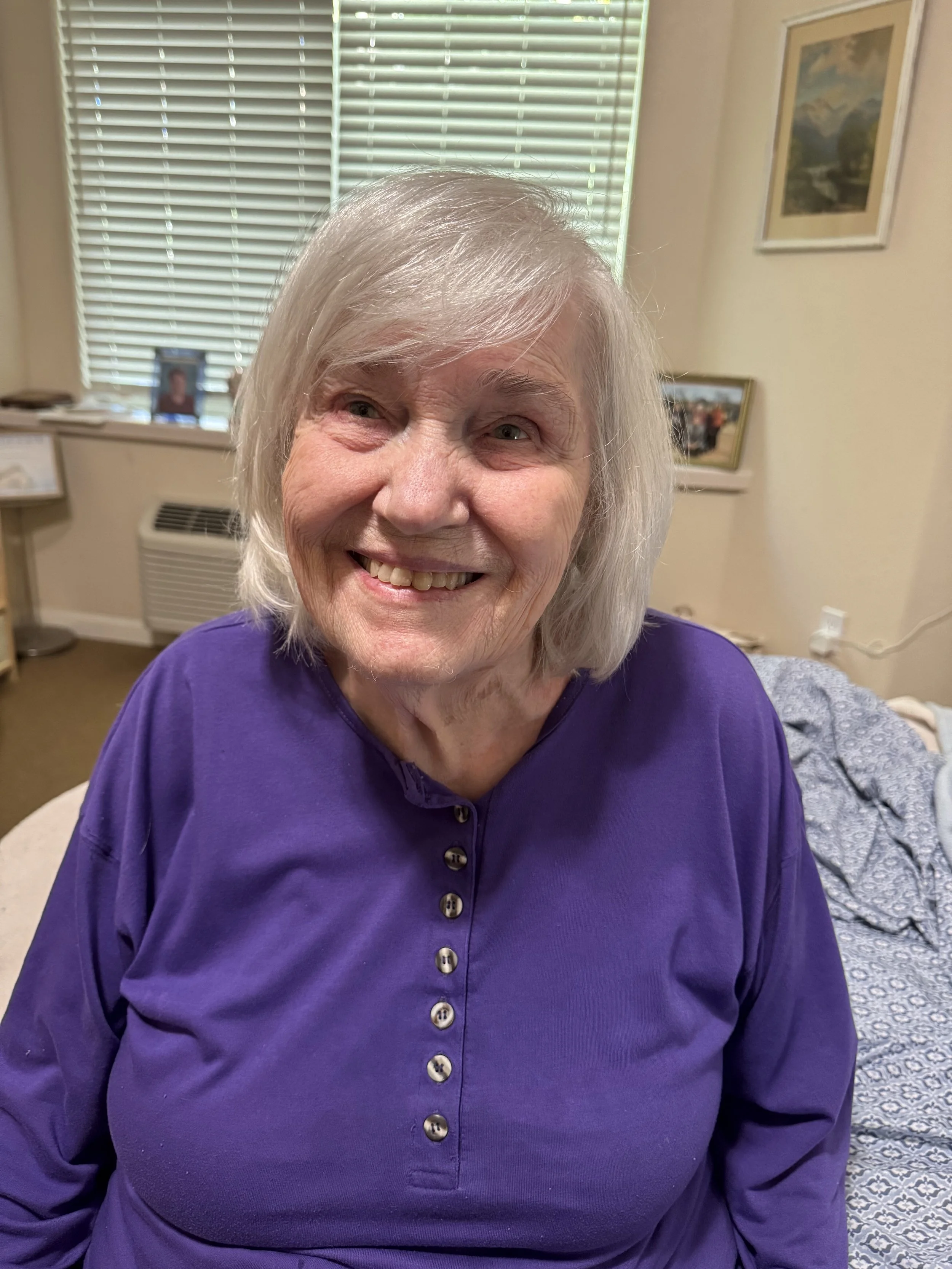
🌿 My Inspiration for Community Service
A tribute to Wanda Lee (Swett Burgess) Ballentine — environmentalist, activist, and mother
And some leave behind something rarer — an ethic.
Politics is often about the promises we make for the future, but character is defined by where we come from. My values — independence, foresight, and a refusal to waste — were not learned in a classroom, but in the garden of a woman who saw the future long before it arrived.
🌱 Before Recycling Had a Symbol
I consider myself an environmentalist because I was raised by one. My mother, Wanda Lee (Swett Burgess) Ballentine, informed others under the email monikers RagingGrannie and EcoNag, and helped stop ozone layer depletion and protested a Hyundai semiconductor plant in Oregon.
She raised us recycling and composting before it became a thing with three circular arrows. We had a can for various metals, a can for glass, a can for aluminum, a can for paper, a can for compost, and a can for the dump.
She worked a vegetable garden (I hate weeding to this day, but I always enjoyed the fresh peas from the pod and the strawberries and wild blackberries growing at our back fence). We had chickens, until the local dogs killed them, and rabbits, all in suburban Mill Valley.
She did this because she grew up during WWII and believed that "moving on" from the Victory Garden and recycling campaigns wasn't progress — it was amnesia.
She was right.
🌉 A San Francisco Native
Wanda Lee Swett was born in San Francisco and raised in Belmont on the Peninsula. She came of age during a time when California was transforming from agricultural paradise to suburban sprawl, and something in her resisted that transformation from the very beginning.
At UCLA in the late 1950s, she was a member of the Human Relations Council, a student organization dedicated to promoting understanding across racial and religious divides. This early work planted the seeds of her lifelong conviction: that individual problems, whether social or environmental, have systemic roots and require collective solutions.
She earned her Master's in Social Work and married Dr. Earl Burgess, a psychiatrist. Together they raised their family in Mill Valley, Marin County, from 1966 to 1985 — my sisters Amelia and Cynthia and me. But while my father treated patients in his office, my mother was developing a different kind of cure for what ailed American society.
📚 A Philosopher of Family and Land
In 1972, my mother's ideas reached a national audience when her chapter, "Learning to Cooperate: A Middle-Class Experiment," was published in The Future of the Family, alongside contributions from Dr. Benjamin Spock, Gail Sheehy, and other leading thinkers of the day.
She argued that the isolated suburban household — where every family owns its own lawnmower, its own washing machine, its own car — was both psychologically destructive and ecologically wasteful.
Her solution was not a government program but a revolution in daily living: cooperation. Share resources with neighbors. Pool childcare. Grow food together. Build community through the practical acts of everyday life.
During the devastating California drought of 1977, ABC7 News featured my mother demonstrating water conservation techniques, using a pump to recycle laundry water for her garden. She wasn't just theorizing about sustainability; she was living it, sometimes pushing the edges of what was permitted by building codes.
✊ The Activist Years
My parents divorced in 1981. In 1990, when we all had grown, my mother moved to Eugene, Oregon, where she lived with her mother and threw herself into environmental activism with renewed intensity. Family, to her, was never disposable. Care was something you did, not something you claimed.
She wrote for local publications about the dangers of corporate power over environmental policy. In 1996, she was among those who opposed Hyundai's massive semiconductor plant near the Willamette River, a facility that would discharge millions of gallons of wastewater daily and use over 700,000 pounds of hydrofluoric acid annually.
She understood, decades before most Americans, that "high-tech" industry could be just as environmentally devastating as smokestacks and strip mines.
As early as 1992, she was active on the internet, then still the province of academics and early adopters, spreading information about protecting the ozone layer. She shared detailed guides on avoiding chlorofluorocarbons and pressuring industry to find alternatives. The Montreal Protocol would eventually prove successful, and activists like my mother were part of that victory.
🌍 A Leader in the Climate Movement
In July 2003, while living in Cleveland, Ohio, my mother helped organize the Global Warming Crisis Council. This was before Al Gore's documentary, before climate change was front-page news. The Council connected over 6,000 activists worldwide, and my mother served as a primary contact point — the person you emailed if you wanted to join the fight.
The Council's principles reflected everything she had learned over four decades of activism:
The driveway is a symbol of isolated, car-dependent, fossil-fuel-consuming suburban life. To depave it is to restore both the earth and the community.
💚 Never Stopping
From 2003 to 2017, living in Eagan, Minnesota, my mother continued her activism. She submitted public comments opposing sulfide mining in the Boundary Waters watershed. She signed petitions to protect the Gray Wolf. She engaged with every regulatory process that affected the environment she loved.
Now 87 years old and living in Petaluma, California, back in the landscape of her youth, she represents what it means to be a citizen in the deepest sense: someone who never stopped believing that individual choices matter, and that the future is something we owe to one another.
🏡 Her Legacy
Wanda Ballentine's legacy is not a single accomplishment, a single job title, or a single public victory. It is something far more enduring: a family raised with conscience, a worldview rooted in responsibility, and a lifetime of refusing to look away.
She taught her children that the planet is not a metaphor — it is a home. She taught that "environmentalism" is not a political identity but an obligation. And she taught that real values don't require applause.
Why This Matters
I am running for Congress because I believe in showing my work, in being transparent about what I stand for and how I'll achieve it. That belief comes directly from my mother.
She didn't just talk about environmental values; she lived them — in our backyard garden and our recycling cans and our compost bins, long before anyone thought it was fashionable.
She understood that the environmental crisis and the crisis of American community are the same crisis. We overconsume because we're isolated. We waste because we don't share. We destroy the planet because we've forgotten how to be neighbors.
The Victory Gardens and recycling campaigns of World War II proved that Americans could live differently when we understood it mattered. My mother never accepted that we should go back to wasteful isolation just because the war was over.
She kept the garden growing. She kept the bins sorted. She kept fighting.
She was right. She still is.